























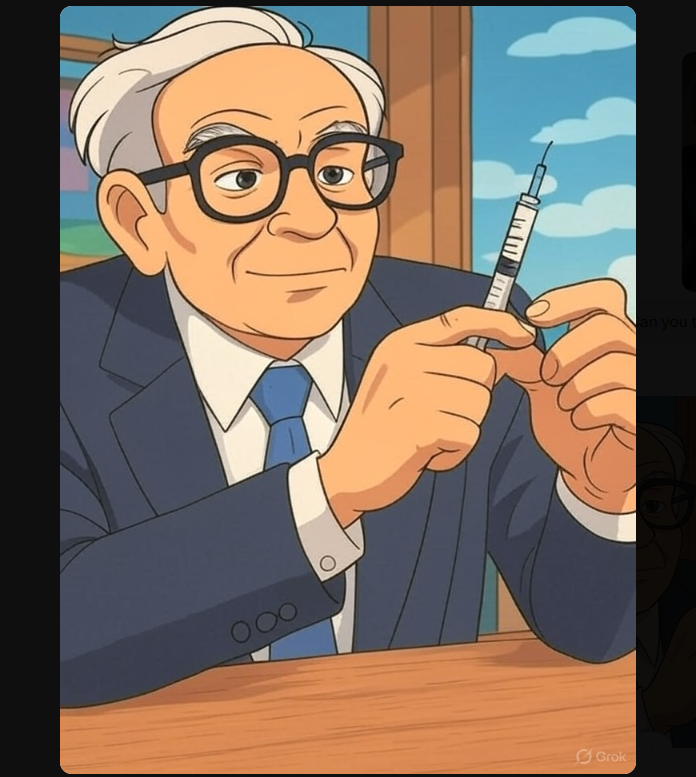
BuWarren Buffett has been widely cited as the world’s greatest investor for years. He was at one point the world’s richest man by total assets. Even though he is no longer running day-to-day operations at Berkshire Hathaway Inc. (NYSE: BRK-B), he is still the “Oracle of Omaha!” And investors listen closely any time Warren Buffett speaks, particularly when it comes to the topic of investing — or about making specific investments.
Buffett’s clout lends credibility when it comes to investing for the long-term. He has directly and indirectly shared many of his methodologies and reasoning behind some of his investments. Many of those same strategies should be used by investors nearing retirement or who are already in retirement.
Oggonomics has prepared a list of Buffett strategies that every long-term investor can try to incorporate. Buffett would admit that his strategies come with no assurances of profits. He has also admitted on many occasions that he has made some horrible investment decisions over his career. Even at the ripe old age of 95 — when Buffett talks, people listen. Some well-known people have even paid millions of dollars just to have a single lunch with him. That’s some serious pedigree.
Oggonomics believes in Buffett’s long-term playbook. This has been distilled from six decades of annual letters, interviews, and even looking at his actual capital allocations. His lessons should offer a timeless guide-book for long-term investors as well, particularly as investors begin to approach retirement and through their retirement.
Buffett’s investments tend to focus on a longer horizon than most of us. He was never looking for short-term trades, nothing like day traders or swing traders would consider. Even then, Buffett has sometimes “only” held investments for a few quarters or a couple years. That’s much shorter than a “buy and hold forever” strategy, but still longer than many of “the rest of us” have the discipline to hold an investment. And for the ultimate evaluation tool, Buffett has preached to own stocks you would want to own even if the stock exchanges were to be closed for a long period of time.
So let’s take walk through Buffett’s strategies, some of the stocks he never sold, and let’s even look at some companies has acquired outright and folded into the Berkshire Hathaway machine. You can probably learn a thing or two about discipline.
CORE STRATEGIES: WHAT BUFFEET ACTUALLY PREACHES
Buffett would warn you that no single strategy is risk-free. Buffett likes businesses that are easy to understand. He loves looking at the long-term views. He loves businesses with wide defendable moats against competition. And he loves having his money work for him, getting paid over and over and letting it grow. Here are four core strategies following what Warren Buffett has preached for years.
1. Buy What You Understand — And Only What You Understand!
Buffett has said repeatedly that he won’t invest in businesses he can’t explain. He famously avoided technology stocks for decades (until Apple and others) because he didn’t feel he had an edge. The lesson for everyday investors: if you can’t describe how a company makes money in two sentences, you probably shouldn’t own it — especially not with retirement money.
2. Hold Forever (Or Close to It)!
“Our favorite holding period is forever,” Buffett wrote in a 1988 letter. He’s not trading in and out. He’s not timing tops. When Berkshire buys a great business at a decent price, the default is to never sell. Coca-Cola, American Express, Moody’s — these aren’t trades. They’re legacy positions. The tax efficiency alone is staggering; unrealized gains compound without the IRS taking a cut every year.
3. Look for a Wide Moat!
Buffett wants businesses with durable competitive advantages — brands, network effects, cost advantages, regulatory permissions — that keep rivals at bay. See’s Candies can raise prices every year because the brand is a gifting tradition. BNSF Railway owns physical track competitors can’t replicate. That’s a moat.
4. Let Compounding Do the Work for You!
“My wealth has come from a combination of living in America, some lucky genes, and compound interest,” Buffett once said. He’s talking about decades, not quarters. For pre-retirees, the message is sharp: the final 10–15 years before retirement are when compounding accelerates hardest, if you don’t blow it up chasing yield or panicking in a correction. Buffett loves dividends, and he has repeatedly referred to compounding interest as “the eighth wonder of the world.”
BUT WAIT, THERE’S MUCH MORE
Every single person who has delved into Warren Buffett’s investing strategies might want focus on Buffett’s number-one view of intrinsic value. Others may take his focus in a company’s return on equity. Others may focus on Buffett’s view of how defendable their business is (or how wide their moat is). And others may believe that Buffett’s love for value in the discount to intrinsic value is his favorite message.
Buffett’s views are also dependent upon present valuations, how the companies have performed in the past, and what he sees for each company’s future. Just don’t forget that even Warren Buffett’s can occasionally stray from his steadfast rules.
Some of Buffett’s strategies that long-term investors can emply should be on what he doesn’t do… He doesn’t usually chase stocks just because they are hot. He doesn’t like to overpay. And sometimes he doesn’t care about market sentiment — hence, “be fearful when others are greedy, and greedy when others are fearful.” Buffett also doesn’t ride a bad decision into the ground if a company’s prospects have changed. Buffett doesn’t like to think of investments as stocks as much as he likes to think of them as a part of his business. And Buffett doesn’t like gambling in risky assets at very lofty valuations (as he warned about in 2026).
WHEN BUFFETT THINKS “FOREVER STOCKS”
Oggonomics has kept track of Berkshire’s 13-F filings over time, and his decades of annual letters spotlight the positions Buffett has held the longest. Some stocks have been on Berkshire’s books back to the 1980s and older, even before the crash of 1987.
Coca-Cola (NYSE: KO) and American Express (NYSE: AXP) are “forever stocks” that have been owned by Berkshire Hathaway for decades. His adjusted prices, based dividends and splits, would even offer a core lesson that investors can eventually own certain stocks “for free” or a tiny fraction of the future share price.
Berkshire began buying Coca-Cola in 1988, eventually accumulating 400 million shares at average split-adjusted cost basis of close to $3.25 per share. That stock was seen above $80, and with ongoing hefty dividends (his yield is based on his purchase price — not the more 2.6% yield you would get if you bought now). Coca-Cola also has more than 60 consecutive years of dividend hikes, even through very adverse times; and it has seen four different 2-for-1 stock splits since Buffett started buying. Is that an annual dividend of 50%, or more based on his original cost basis? That’s not a typo. It’s what can happen when you buy a wide-moat dividend grower and never sell.
Buffett’s perpetual love affair with AmEx dates to the 1960s during what was called the “salad oil scandal,” and back when credit cards were still an emerging major growth engine for the economy. Berkshire Hathaway now holds a 22% stake worth nearly $50 billion. Buffett’s take: AmEx has a closed-loop network, premium customers, and still maintains pricing power to this day despite strong competition. You might even think of AmEx as a toll bridge on affluent spending.
And what about when “forever” is more like “forever-ish” and opportunistic based on disparities and market circumstances? He has done that too.
Buffett is an opportunist (again, think about greed and fear). He decided to enter into strategic investments during the global financial crisis, when most investors who could stay in the market were busy biting their pillows. He also negotiated better deals that the government received in their bailout investments. Berkshire Hathaway made some key investments in companies that were troubled but ones that Buffett thought could recovery handily. Here are some of those buys:
- Goldman Sachs $5 billion, with perpetual preferred shares and warrants.
- General Electric $3 billion, with preferred shares and warrants.
- Bank of America $5 billion, with preferred shares and warrants.
- A combined $550 million in face value of Harley-Davidson and Tiffany.
Buffett disciples do not have to fear investing in technology stocks, within reason. Buffett and his team decided that not all technology stocks are too risky to own. Apple Inc. (NASDAQ: AAPL) has been trimmed over time, but Berkshire owned north of 227 million shares on last look. With shares recently above $300, that was worth about $350 billion inside of the Berkshire portfolio. Alphabet Inc. (NASDAQ: GOOGL) was also a fairly recent acquisition, which Buffett and his team decided was a wide moat business, with strong cash flow and even at decent valuations when they acquired the stock — and so what if its stock went from under $300 in March to $400 in May (2026)! Buffett has made other technology buys as well, with mixed results over time.
WHEN BUFFETT JUST BUYS IT ALL
Berkshire Hathaway made some major acquisitions under Warren Buffett over the years. This is when Buffett likes a business so much that he just buys it all up in an acquisition. The acquisitions of GEICO and BURLINGTON NORTHERN SANTA FE should stand out as key mergers.
Berkshire acquired the rest of GEICO (the auto insurer) in 1996 for $2.3 billion, after owning a long-term stake in the business. GEICO has since grown into one of the largest car insurers in the U.S. today with a cute little gecko mascot, and its $40 billion in annual premiums now makes it a core operation for Berkshire. GEICO also throws off cash significant cash that the conglomerate can redeploy into stocks, bonds or even to help fund new acquisitions.
In 2010, Berkshire completed a $26 billion for the BNSF Railway (about 440 billion in total after debt) as the then-largest acquisition in Buffett’s career. BNSF rail system hauls coal, grain, consumer goods, and industrial freight across 32,500 miles of track. Buffett thinks of it as a bet on the American economy, and BNSF also has a capital-intensive moat that other railroads and transportation companies cannot easily replicate.
Berkshire announced the acquisition of Precision Castparts in a $37 billion deal in 2015 for its parts manufacturing in aerospace. While Buffett once said it was a bad deal that he paid too much for (with a $10 billion write-down in 2021), the value of the business has recovered and Buffett didn’t seem to be bothered about the business leading up to his semi-retirement.
Investors should understand up front that they will not be able to copy Buffett’s model of making a huge outright acquisition. What investors can still learn from these acquisitions is thinking about “easy to understand” companies they may want to buy and hold forever — with limited competition and without ever having the headache of running the company.
WHY OGGONOMICS CARES & PRE-RETIREES SHOULD, TOO!
Investors know that they can’t be Warren Buffett. They don’t have hundreds of billions to play with, no access to private deals, nor do they have tax advantages like a holding-company structure. What they can do is copy or replicate his life of investing by owning fewer things, understanding them all, and by letting the passage of time work in their favor.
Pre-retirement investors who have 20 years or less before retiring have to think differently than investors in their 20s and 30s. Hopefully you aren’t building wealth from zero at this point, whereas younger investors seem to have all the time in the world. Using Buffett’s strategies can protect the savings and nest eggs already built and allow that compound interest (or dividends) grow into a paycheck-replacement machine.
Buffett’s claim of over 19% annualized returns may not be a realistic goal for most investors, but even 8–10% returns compounded over 15–20 years can build an investment portfolio into a solid retirement engine.
And investors shouldn’t have to panic in the event of adverse market conditions. Buffett didn’t day trade, he survived the dot-com bubble, and was greedy when others were fearful during the global financial crisis. He made it through the 1987 crash and COVID in 2020, and survived every market correction before, during and since those adverse economic conditions. His forever stocks stayed forever stocks.
Pre-Retirees and retirees have to care about quality over speculation. Having solid businesses like insurers, Coca-Cola, American Express, railroads and energy companies will likely be safer than chasing the next AI announcement, meme stocks, and even cryptocurrencies that may be too hard to fathom.
ONE LAST LOOK FROM WALL STREET
Almost a decade ago, the investment banking firm Jefferies outlined some specific points that Buffett uses in his evaluations for investing. These are just some of those points summarized into brief bullet points:
- Is the business simple and easy to understand?
- Does it have a consistent operating history?
- Does it have favorable long-term prospects?
- Truth & Transparency — Is management candid with the shareholders?
- Does management resist “groupthink and the “institutional imperative”?
- Is management rational with the company’s capital?
- Does management focus on return on equity?
- Does the business have a high profit margin?
- Does the company create $1 of market value for every $1 retained?
- Can the company be purchased at a significant discount to its intrinsic value?
There you go. You now have your crash course on how to invest like Warren Buffett. And now for the hardest part — waiting year in and year out for that nest egg to grow and throw off serious cash in your future.