





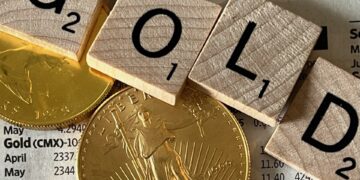

















There are many reasons to own gold and silver. The problem is that gold and silver prices surged to a blow-off top,” only to face what some owners would call a correction and what other owners would call a crash. The 2025 euphoria for gold and silver peaked right at the start of 2026 and the selling has turned into gloom and doom. Investors need to know the mechanics before they can know when the bottom will come into play.
Many owners think of most precious metals as being closely correlated, but gold and silver are quite different and the “reasons to own them” are also quite different. And most investors should know they won’t ever catch the perfect top to sell and the perfect bottom to buy.
Oggonomics cares about gold and silver. It is important to understand what has continued to drive the sell-off in 2026 after years of significant gains. It’s not just profit-taking at this point. Not at all. That said, there are many positives for gold and silver beyond the more recent panic.
Up to the peaks in early 2026, gold had rallied 200% and silver had rallied 300% in less than three years. Those are massive moves. But since those peaks, gold has fallen 25% and silver has fallen 45%. The early 2026 peaks for gold and silver were classic “blow-off tops” when using technical terms. It should be no surprise that the follow-on move was a massive sell-off. After all, that’s what is supposed to happen after a “blow-off top.” There is still more to the story other than just technical analysis and profit taking.
Gold and silver have withstood the tests of time. Think about this for a moment — gold and silver have both been used as core investments and were counted as the basis of wealth for far longer than stocks and bonds have been around. National currencies used to be backed by gold, and “coins” as currency were historically made of gold and silver. The wealth of nations was even tied to how much gold a kingdom had. Those may be lessons in history, but the world’s central banks still keep gold reserves as a basis of backstopping their currencies.
Those who own gold and silver have to be wondering (or worrying) just how much more selling can be expected in 2026 after pulling back so much from their peaks. Many long-term fundamentals remain quite positive for both gold and silver. The strategic issue in 2026 is that short-term and real-world issues have continued to add to the selling pressure. And some of those concerns may persist for a while longer.
Oggonomics is outlining the key forces that have continued to add to the selling pressure in 2026. Some of these will reverse course, but “when” is the tricky part. It may take more than a “deal” with Iran.
STRONGER ECONOMIC NUMBERS
Stronger than expected U.S. payroll data and rising Treasury yields have added to the sharp selloff in gold and silver. A stronger jobs report seems like a hard pill to swallow as a reason for selling. A good economy should help asset prices, right? Not always, and not right now.
Higher inflation is supporting the belief of “higher interest rates for longer.” One conundrum for long-term gold owners is that gold is often considered a hedge against inflation. That doesn’t mean gold (and silver) prices react well on rekindled inflation fears, with recent pops in the CPI/PPI inflation data have been driven by oil and international conflict in Iran and the Middle East.
As gold and silver pay no interest or dividends, investors can go for the “risk-free” rate of return purchasing higher Treasury yields. Rather than the ongoing expectations of a new Federal Reserve chairman cutting interest rates, now the markets are worried that rate-hikes may have to come back into the picture. If interest rates rise much further because of stronger economic readings (or because of inflation), that should continue to be a drag on gold and silver in the near-term.
THAT DAMNED STRONG DOLLAR
A stronger U.S. dollar is one of the most direct headwinds for precious metals. As gold and silver are priced in U.S. dollars, a rising dollar (using supply/demand trends) makes gold and silver more expensive for foreign buyers. If it’s more expensive, that reduces demand.
The U.S. dollar is also still considered to be the safe-haven currency in global markets. If the dollar’s strength continues, even if only because of higher interest rates, then the pressure on gold and silver may remain in place.
If global investors can get a higher yield in dollars than in Yen and Euros, then they have to convert their currencies to dollars to buy Treasuries. If you consider that money will chase yields and returns in a simpleton approach, then it partly explains the currency issue.
DO CHARTS & TECHNICALS MATTER?
You already heard about the “blow-off top” and the selling that follows. Since the metals had risen so much with no serious corrections, the support lines are lower for both gold and silver. While gold recovered 2% to $4,200 on news of a potential “deal” with Iran, silver’s recovery was 4% to $67. But what if gold and silver or the Iran “deal” fail to hold?
If $4,000 fails to act as support for gold, then the prior resistance level of $3,500 from the first-half of 2026 may come into focus. As silver fell under $70 again, the prices of $62 to $64 have been support in 2026. If these support levels fail to hold, then traders will look at prior 2025 resistance levels of $58 and $54 as the next likely support lines for silver.
In some ways, investors can think of charts and support and resistance levels as elevators in a 100-story skyscraper. Those elevators rarely stop at every floor on the way up and down. And sometimes those elevators move much faster than people would guess.
GEOPOLITICS & UNCERTAINTY
The prices of gold and silver are inherently tied to geopolitics and uncertainty. Gold, perhaps even more than the U.S. dollar, is considered “the ultimate risk and uncertainty haven.” The war in Ukraine and the fighting against Iran remain ongoing issues, with a pending “deal” in the works. The latter drove an instant spike in oil prices, and as people, industries and governments have to spend more on energy they have less capital to buy gold and silver. That’s admittedly a very remedial explanation, but if it continues or gets worse and lasts for a long time it will be part of the equation.
The financial media uses the term “uncertainty” far too much. If you hear about “uncertainty” all day long, day-in and day-out, it may prevent you from sticking to your spending or investing plans. Do we dare address a belief that the media uses “uncertainty” to keep your attention? Try listening to Don Henley’s “Dirty Laundry” song again and you will understand the mainstream media.
SILVER’S SOCIETY ROLE: DIFFERENT THAN GOLD
While gold and silver are often given the same thought process for investors, the actual uses of gold and silver are quite different. Don’t just think about jewelry here. Silver is needed in a variety of industrial uses — solar panels, autos, electric engines, electronics, coatings, and even AI infrastructure.
Many industries that have used gold in the past looked for other alternatives even as the price of gold was under $2,000 per ounce. It turns out that $2,000 for one ounce of material is still quite expensive for industrial uses. Now imagine needing that gold and having to pay $4,000 or $5,000 for just a single ounce.
MORE REASONS FOR THE GOLD BUGS
There are many reasons outside of just “investment” in physical gold/silver and ETFs that gold bugs remain optimistic for the long-term. Not every single one of these factors will be present at once, but many of these issues get thrown into the mix depending on what’s happening in the world and the economy.
Oggonomics has laid out some of the non-investment issues that support a bullish thesis for gold after the near-term issues are ultimately resolved. Some of the issues might make you chuckle, but some are absolutely real issues that support long-term gold demand beyond mere investing for exposure.
1. The Debasement Trade…
The endlessly rising sovereign debt and continued lack of confidence in fiat monetary systems should be a positive for gold in the long run. At what point does the total U.S. deficit matter? At $39.2 trillion, it will reach $40 trillion quite soon. Will $45 trillion or $50 trillion be the straw that breaks the camel’s back?
The U.S. is not alone in its deficit challenges despite a 124% Debt-to-GDP ratio. Japan had a Debt-to-GDP ratio of 237%, and nations like Singapore (173%), Greece (154%), Italy (135%), France (113%), Canada (111%) and Spain (102%) should all stand out as problem children behind the worries backing the debasement trade.
2. De-Dollarization Likely to Continue…
It is no secret that multiple nations have been trying the de-dollarization route of lightening up the U.S. dollar-based assets. Central banks of China, Poland, India, and Turkey have been replacing dollar-denominated reserves with gold. That said, a Bloomberg report in June noted that Reserve Bank of India likely sold $12 billion of its gold reserves and purchased $7.5 billion in foreign currency for its reserves — citing sustained capital outflows and higher oil prices as the conflict in Iran and the Strait of Hormuz dragged on.
There has been growing domestic political pressure in Germany and Italy to repatriate their gold from the Federal Reserve Bank of New York. Whether this actually (or fully) occurs remains to be seen. U.S. tariffs and trade spats are often cited in the de-dollarization case.
3. Mining & Refining Challenges Will Continue…
Mining for strong gold deposits isn’t what it used to be. It seems every mountain has been searched for the so-called Motherlodes, and some locations where gold reserves are located are not easy to get to or have serious environmental risks associated with them. Strip mining requires massive amounts of nasty chemicals to help extract the gold, and then the land there is effectively rendered worthless for generations ahead. The all-in sustaining costs represent how much it costs each producer and miner to actually get their gold, and these costs have risen along with the price of gold.
Silver has its issues too. Mining for silver is not keeping up with demand. 2026 is yet another year where silver demand has outpaced what can be mined. If you haven’t read about silver refining issues blocking sellers from getting market prices for their silver, it is interesting to say the least. It also didn’t that the banks put a squeeze on those refiners as well.
4. Wall Street Remains Bullish…
Most Wall Street strategists have not thrown in the towel on gold (and silver). The consensus is that the pullback is a better entry point rather than a full market reversal. Even as recently as April-2026, when the selling was already well underway, Wall Street’s top investment banks were still loaded up with bull market forecasts (except one, maybe) that would please any gold bug:
- BofA — $6,000
- Goldman Sachs — $5,400
- ING — $5,000
- JPMorgan — $6,300
- Morgan Stanley — $4,800
- UBS — $6,200
- Wells Fargo — $6,100 to $6,300
- HSBC was the dissenting forecast — with a range of $3,50 to $5,050.
5. What If the Government’s Gold Isn’t Really There?
You have probably heard the age-old rumors that “Fort Knox is empty” before. The U.S. Mint shows over 147.3 million fine troy ounces being held there in the form of “good delivery” bars. The U.S. Treasury books the reserves at $42.222 per ounce, which was fixed by law in 1973. These rumors have been debunked on multiple occasions, but many of the people who only want to own gold just can’t let that story go.
6. Did Doomsday Preppers Go Away?
You have head of the good old doomsday preppers before. There is problem with counting the number of actual preppers, cited widely as 20 million. You don’t have to be looking for doomsday scenarios like overnight bank failures, widespread utility and infrastructure failures, civil war, EMP blasts, plagues, national cyberattacks, climate crisis and widescale natural disasters to have items in case basic functions in the economy break down.
Many owners of gold and silver own the metals as a form of barter or currency if any of these major issues ever arise. They might be better owning ammo, large water supplies and meals ready to eat (MREs) — but one of the favorite supplies for preppers is gold and silver. If they really are buyers, do they feel they own enough?