














 The Federal Reserve’s Federal Open Market Committee (FOMC) controls short-term rates via Fed Funds. The financial markets are usually more in control of intermediate-term and long-term rates. With some fresh media reports calling for an increased chance of an emergency interest rate cut by the Fed, Oggonomics would urge its readers and investors in general to not expect an emergency rate cut. That can of course change, but… What are the factors that actually trigger emergency rate cuts?
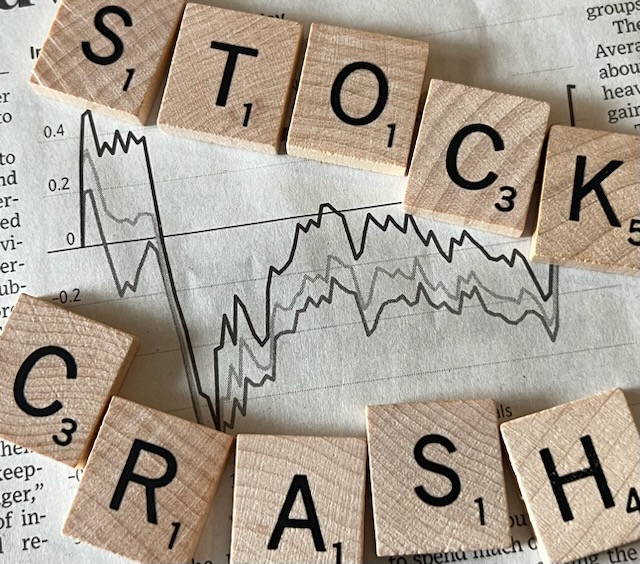
The Federal Reserve’s history of rate cuts and rate hikes is usually reserved for scheduled FOMC meetings throughout the year. If you go back over a 40-year history, even when the Fed didn’t make policy statements and have regular announcements, this latest stock market sell-off is nowhere enough of a reason to force Jerome Powell’s hand. Nor is a slowing of corporate earnings, nor is weaker guidance. Now is last week’s weak employment report. And a one-day or one-week sell-off like has been seen in the U.S. should not even be considered a crash. It’s nowhere even close to a crash.
For starters, the Federal Reserve hasn’t even started actually lowering rates yet. Emergency cuts, or intermeeting cuts, are generally reserved for periods of much greater uncertainty or outright panic. The “inter-meeting cuts” also generally occur after a rate cycle has started.
Oggonomics would like to review the actual criteria that would force the Fed’s hand into an emergency rate cut. Japan’s one-day 12.4% drop is one thing, but that’s a 17% drop in two days. If the sell-off were to turn into something far worse, that is a different matter. And anything is possible. But… Investors and traders alike should ask how many times over 2024 that Jerome Powell and the voting Fed presidents on the FOMC have signaled rates should stay higher until inflation abates back toward the 2.0% to 2.5% target range.
The level of each crisis at any given time is dependent upon the economic snapshot of each period rather than a static boiler-plate scenario. Stocks alone do not usually drive rate cuts. Again, usually. The end of the “carry trade” in Japan seems to have exacerbated the Japanese stock market drop overseas and then in the U.S. This carry trade is where hedge funds and other institutional investors borrow billions of dollars worth of a currency (Japanese yen in this case) at lower rates and with a weak currency and then turning around and investing those funds in higher-yielding assets and/or riskier assets such as tech stocks. It works out great if things remain as they were. As you have seen, a rapid unwind can be brutal when it’s being seen.
Oggonomics is all about strategic investing. This is where assets are strategically placed rather than just left to sit with a hope and a prayer in stock and bond indexes. Even with some traders and investors thinking “there’s always a bull market somewhere,” Oggonomics still sees limitations to its “strategic” placements. Please keep in mind that over 99% of the public isn’t even capable of borrowing money to be repaid in Japanese yen while investing elsewhere in other currencies until repayment is made (back in Yen).
Again, the unwind of a “carry trade” can be quite sloppy for financial markets when it is happening. That’s what you likely saw today as the CBOE Volatility Index (the VIX) was up over 60 briefly. This carry trade unwind is also likely not the end of an era. BofA predicts 2-3 months of volatility. And we all need to keep in mind that Jerome Powell and the FOMC raised interest rates 11 times to get Fed Funds to the current 5.25% to 5.50% target that has been in place for all of 2024.
Oggonomics believes the next directional 100 basis point move in short-term rates is down rather than up. Still, expecting an emergency rate cut ahead of the September FOMC meeting would be a very unusual action by the Federal Reserve. Is there another pandemic or global financial crisis we do not know about? There could of course be more military conflict that comes to pass, but is outright warfare being telegraphed today?
The FOMC members have also telegraphed too many times to count that short-term rates need to stay higher until inflation gets back to 2.0% to 2.5%. This team seems unlikely to flinch and suddenly panic with an emergency rate cut. If an emergency rate cut were to come, barring unknown international events, the cuts could even have the opposite effect. Traders and investors might worry that the Fed sees something far worse happening than the markets were expecting.
So, let’s go over the criteria and the history that has led to emergency rate cuts in the past to determine if we should really expect an emergency rate cut now or in the near future.
NORMAL RATE CYCLE INITIATIONS
The Federal Reserve prefers to begin new interest rate cycles, periods of rate hikes and cuts, at scheduled FOMC meetings. That’s the “first” of multiple actions for it to be a cycle. There are no laws or policies enforcing or preventing an emergency first-move in a cycle. That said, why cause a panic when the Fed presidents can jaw-bone the markets with communication rather than using blunt-force actions like actual cuts? The Fed cannot just invoke an emergency action and then decide to reverse its policies in a short period of time.
WHEN EMERGENCY RATE CUTS OCCUR
The ongoing rule of thumb is that interest rate changes take many months to even factor into the real economy. The Fed usually wants to wait and see how their rate cuts or hikes play into the economy rather than blindly shoot from the hip. After the first or second rate cycle change (cut or hike) is when emergency actions are most likely to come into play. Does it even matter that the FOMC did not used to even hold news conferences or have detailed statements about its rate decisions in prior decades?
Again, keep in mind that the FOMC raised the Fed Funds rates 11 times to get to the current 5.25% to 5.50% range. To cut rates in an emergency when the economy hasn’t fallen off the proverbial cliff with positive GDP still expected would be telegraphing that the FOMC grossly overshot on its rate hikes.
IT TAKES REAL CRISIS
If there are eight FOMC meetings each year, that’s 80 FOMC meetings a decade. Going back to the stock market crash of 1987 is 37 years ago — which would be roughly 296 FOMC meetings ago if the Fed’s timeline were exactly as it has been in 2024. There have only been a few instances of surprise rate cuts since 1987. Since that time, we have endured military actions, terror attacks, global financial panic, entire banking sector bailouts, and a global pandemic.
Now it’s time go over the 6 instances since 1987 that did trigger emergency rate cuts. And we cannot forget about the one year with emergency inter-meeting rate hikes as well.
1) BLACK MONDAY CRASH of 1987
The 1987 Crash in October was called “Black Monday” after Japanese stocks fell almost 15% and Hong Kong stocks fell nearly 40. The U.S. markets were in chaos, with many investors unable to even execute traders. The Dow Jones Industrial Average fell over 22% in a single day and the S&P 500 fell by about 30%. The Fed did cut rates to stabilize the markets the following day — and another unscheduled cut was seen in January 1988.
2) THE EARLY 1990s and THE GULF WAR
The end of the 1980s brought a severe inversion in Treasury interest rates, with short-term rates getting back over 10%. This should make the current 5-percent-plus short term rates look like amateur hour. Then came the Gulf War after Iraq invaded Kuwait. The Federal Reserve, which was not making formal routine statements at the time, had multiple intra-meeting Fed Funds rate cuts from July of 1990 through September of 1992. The FOMC was just not a public-facing entity at that time. The public found out about rate cuts only after transmission by the news wires had been seen by the largest financial institutions.
3) LONG-TERM CAPITAL FALLOUT in 1998
Would a single hedge fund cause a global market implosion? In October of 1998, Fed Chairman Alan Greenspan invoked a single emergency rate cut to assist in the orderly liquidation of hedge fund Long-Term Capital Management after the Asian “contagion” and 1998 Russian financial crisis spread. The hedge fund was greatly leveraged and was caught on the wrong side of the markets at the time, but a $4.6 billion loss and a $3.6 billion recapitalization (bailout) seem tiny by modern standards. The Fed’s action was noted as “growing caution by lenders and unsettled conditions in financial markets” and the Fed effectively further eased its monetary policy stance “to be warranted to sustain economic growth in the context of contained inflation.” Rates at that time were 5.0%, down from 5.25%.
4) THEN THERE WAS 2001
It’s not the norm for a dual systemic risk to come about in a single year. In 2001, the economy was reeling after valuations collapsed in 2000 as the dot-com bubble burst after peaking the prior March. And in September of 2001, the 9/11 terror attacks came from left field — prompting a one-week shutdown for the U.S. financial markets, followed by massive corporate layoff announcements that were brought forward by companies already feeling a slower economy. Three unscheduled rate cuts were seen in 2001, with one cut immediately after the September 11 attacks before the markets opened the following Monday.
5) GLOBAL FINANCIAL CRISIS (2008)
The excesses of the early 2000s came to a head as a housing bubble, a credit crisis, financial derivatives, excess leverage, and high asset valuations here and overseas all led to the Global Financial Crisis. This led to panic selling on Wall Street, then the implosion and bailout acquisition of Bear Stearns, and ultimately the bankruptcy and unwind of Lehman Brothers. In 2008, the FOMC’s 2 emergency rate cuts were in January and October.
6) THE COVID-19 RESPONSE of 2020
If you don’t recall the financial panic of February and March 2020, you don’t need to ever read anything tied to financial news ever again. The S&P 500 fell from almost 3,400 in the first half of February to under 2,300 in only about five weeks. As companies were sending workers to work from home at the start of the pandemic, and awaiting that would be the Paycheck Protection Program to prevent an instant mass unemployment, the Fed used emergency rate cuts twice in a month — once on March 3 and again on March 15. That took rates from almost 2.0% down to the 0.25% level.
7) DON’T FORGET EMERGENCY RATE HIKES
There are times when the Fed just cannot raise rates fast enough to combat inflation and an overheating economy. Alan Greenspan’s FOMC issued a single emergency rate hike in early 1994. From the end of 1993 to early 1995, Fed Funds were raised on multiple occasions — starting at 3% and ending up at 6%. This was after the rate cycle had started an the April 1994 surprise hike too Fed Funds to 3.7% after a hike to 3.5% at the prior FOMC meeting.