


























U.S. investors do not pay attention to the European Central Bank in the same manner as they pay attention to the U.S. Federal Reserve. That said, the ECB has its own monetary policies and a voice that can reverberate far outside of Europe alone. And investors usually listen up when any major central bank is warning about the next correction.
The ECB has made a significant warning in its own blog post that stock market valuations are sky-high as investors have made big AI-related bets. And in their own words, a stock market correction looks probable. Investors probably wonder “how probable” considering that this warning comes from one of the top central banks.
While some valuation concerns are frequently dismissed by investors, the use of “overexuberance” in this post may have some similarities to past warnings from former U.S. Fed Chairman Alan Greenspan in his speech that is now 30 years old. Greenspan’s use of the term “irrational exuberance” became a common reference for years, and it became a hallmark reference for the Dot-Com bubble even though that bubble did not burst until early in 2000.
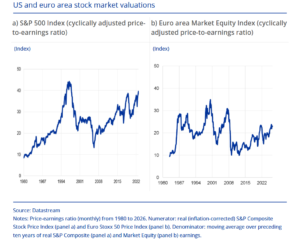
Valuation concerns brought up by central banks should always be given at least some consideration. After all, if the market is ever “priced for perfection” then any disappointment, hiccup or slow-down can create significant selling pressure. And while the ECB’s valuation warning does not necessarily predict an imminent correction, the team behind the post is warning that market valuations have now reached levels that have not been seen since the Dot-Com bubble.
The ECB’s specific warning — “Economic research on past technological revolutions points to a worrisome conclusion: a correction of current stock-market valuations is likely.”
One significant difference between today’s AI-boom and the Dot-Com bubble in the ECB post is that there is less room to cut interest rates or use fiscal policy support at the present time to buffer any fallout. And the ECB also warned that a correction would have severe consequences even for the eurozone because so many investors have direct exposure here. It’s not even just exposure to the Magnificent Seven in the U.S. — but to an “overexuberance” in European stock markets as well.
The August 17 ECB blog post has a large team behind it (Malin Andersson, Johannes Breckenfelder, Stefano Corradin, Kalin Nikolov and Maria Antonietta Viola). Multiple concerns are voiced up front:
- Valuations (CAPE Ratio) on the US stock market are currently close to their historical peak.
- Euro area equity valuations have also risen, albeit to a lesser extent.
- Markets on both sides of the Atlantic reflect enthusiasm about AI shaping the economy and driving profits.
- A correction should be expected even if current valuations are rational.
In the end, the team behind this report (which is not the official view of the ECB or Eurozone, per its disclaimer) warns that technological revolutions carry risks of a boom-bust cycle in asset prices. It also flags that this risk does not depend on today’s valuations being rational or irrational. One key admission or observation is that a serious correction would not just be limited to the U.S.:
The effects of a US correction could extend beyond financial markets to euro area sentiment, financing conditions and hiring. A US AI fallout would not remain a US problem.
There you have it. How you choose to interpret this “boom-bust” presentation is up to you.